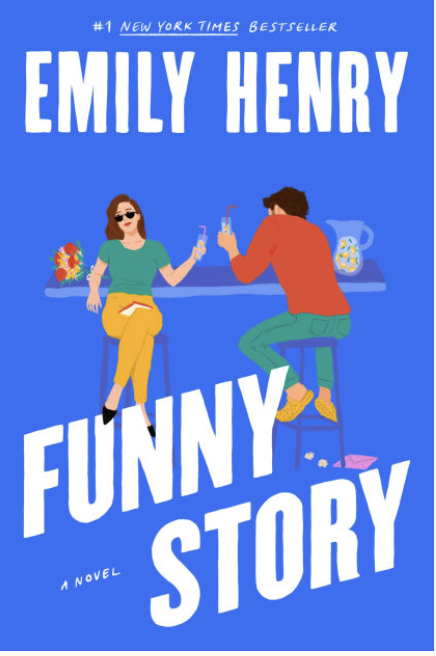
Last month, I wrote about typing in blue for many reasons, one of them being the association of the color with the winter months. Ironically, to circumvent the blues that are typically associated with this time of year, I’ve made it my mission to enjoy beach reads as my literature companions during this half of the year. The following post is a review of Emily Henry’s Funny Story.

I picked up Funny Story in the Palm Springs airport in California after a week of an academic excursion. I was in need of something light for the plane ride, and the cobalt blue cover and juxtaposition of the male and female figures immediately drew my attention. I flipped the book around to read that paragraph that tells you enough to want to buy the book, but not enough to not blame yourself if you end up hating it.

I caught the main character names, and as they say, don’t judge a book by its cover—but there are no rules against judging it by its character names. I liked the sound of Daphne and Miles, the frustration of potentially predicting the book’s ending from the title, and the curiosity of perhaps having too inflated an ego because of the book’s popularity. Surely, if the ending were that obvious, it wouldn’t be a bestseller.

I’m happy to say that I do not regret my choice of purchasing the book. If you’re looking for a funny, lighthearted, endearing, gutting yet uplifting story, Funny Story is exactly that. I rate it 3.9/5 stars.

At its core, Funny Story follows Daphne, a librarian whose carefully planned life collapses when her fiancé, Peter, leaves her for his childhood best friend, Petra. Stranded in a town that was never meant to be hers and with nowhere else to go, Daphne ends up living with the one person who understands her humiliation better than anyone: Miles, Petra’s ex-boyfriend.

Miles and Daphne could not be more different. Daphne is reserved, orderly, and emotionally guarded, while Miles is messy, impulsive, and seemingly allergic to seriousness. Their shared heartbreak initially makes them reluctant roommates rather than companions. But as they begin navigating their new lives—working, making friends, and trying to reclaim a sense of self—they form an unlikely bond.

What begins as a temporary arrangement slowly evolves into something deeper as the two help each other process betrayal, rediscover confidence, and rethink what love is supposed to look like. The novel blends humor and vulnerability, using sharp dialogue and awkwardly honest moments to explore heartbreak, identity, and the strange ways people rebuild after plans fall apart.

I am convinced that Emily Henry is one of the few people on earth who doesn’t struggle with words. For every uncomfortable, unutterable feeling and sensation we have, Emily Henry seems to have the perfect way to translate it onto paper. It is this seamless glide between emotion and articulation that makes the book really worthwhile.

We are not prisoners to the sadness of either Daphne or Miles, but rather willing spectators—and eventually participants—in their attempts to heal, rebuild, examine, and overcome such painful circumstances. Along the way we make pit stops at father–daughter dynamics, female friendships, regret, and insecurity, and finally land in the resolution and reconciliation of them all.

In essence, we also learn that when we are faced with the actions of others that seem cruel, we do not need to go higher or lower, but rather inward—toward self, community, and connection.

And to make sense of this, I highly suggest you make Funny Story your next read come sun or snow .